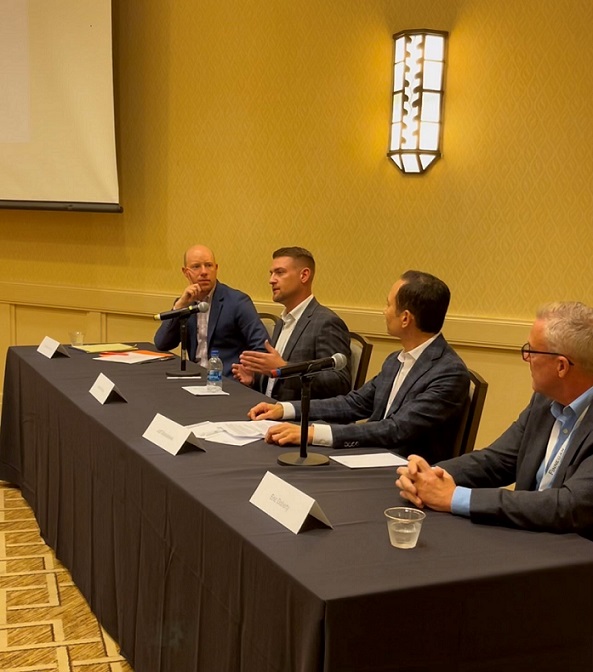
Last week, at the annual Southeast Life Sciences Conference, organizations like SCBIO, Bio Alabama, Georgia Bio, Life Science Tennessee, NC Bio, and Virginia Bio all gathered with top life sciences companies to network and discuss ways to advance healthcare. Austin Shirley, VP of Commercial Operations at Diversified Medical Healthcare (DMH), and team were at the conference representing all the DMH brands including Premier Medical Laboratory Services (PMLS), CPT, OnGen, and Vessel Medical. During the conference, Austin joined Eric Doherty, President of Blink Science, and Joff Masukawa, President of Diligentia Strategy, for a panel discussion titled “Diagnostics: Moving to the Forefront of Global Healthcare.”
The panel kicked off with the impact of the COVID-19 pandemic on the rapidly evolving diagnostics industry. In 2020, labs and healthcare facilities quickly had to shift gears as the virus spread around the U.S. The pandemic disrupted and even destabilized the industry as a whole, creating obstacles to overcome for labs like PMLS and its sister companies. Although these challenges were presented, they had a profound impact on the life sciences industry and even forced many companies in the life sciences to expand their offerings. As a result, in many ways, companies in life sciences improved and/or changed a lot of their protocols and processes for a more efficient infrastructure.
As an example, Diversified Medical companies were positioned to meet infrastructure restrictions head-on with a facility already FDA registered and already conducting molecular testing. “We started to notice on the lab side that the supply chain for specimen collection kits and viral transport media was one of the biggest issues,” said Austin Shirley. “So, we began manufacturing these through our company, CPT Medical. We were able to supply our lab with specimen collection kits and keep testing without any hiccups from the supply chain. We also sold these kits to other labs and still are. I think last week we passed a milestone of 2 million specimen collection kits manufactured from a company (CPT Medical) that, a year and a half ago, wasn’t in the business of that.”
Overall, the pandemic put a spotlight on the diagnostics industry and its role in the global healthcare ecosystem, but what about its future? In the panel discussion, Austin delved into rapid point of care testing and how personalized care will affect the future of diagnostics. “Diagnostics could play a role, really in preventative health and how we integrate biometric data from rapid point of care tests into a patient’s polygenic risk score.” He continued to discuss the sensitivity and specificity of point of care assays and how, as we move forward with the accumulation of more data, we will improve the accuracy of point of care testing to make diagnostic testing faster for better patient outcomes. He also explored how, with the help of artificial intelligence, personalized care can be used more to prevent disease rather than just to diagnose currently existing diseases within patients.
The SE Life Sciences conference and the discussion panel itself were an impactful platform to discuss our plans to move healthcare forward and how we can work with like-minded companies, Blink Science and Diligentia Strategy, to make healthcare more efficient and effective for advanced and more individualized patient care.
]]>As the first in a series of upcoming scientific panel discussions hosted at Premier Medical Laboratory Services (PMLS), Dr. Brian Krueger, Chief Scientific Officer of PMLS, and Dr. Stewart Holt, Molecular Diagnostic Technical Supervisor, talk about a wide range of COVID-19 topics including variants, masks, and vaccines.
Dr. Krueger currently oversees scientific functions at PMLS and developed the first commercially authorized SARS CoV-2 COVID-19 test. Meanwhile, Dr. Holt holds over 25 years of experience as a genetics and diagnostics scientist.
Both tackle the misconceptions many of us may have encountered across social media. The CDC says misconceptions or misinformation play a big part in many Americans not wearing masks and not getting vaccinated. Dr. Krueger says, “there’s a lot of misinformation about masks out there,” and we should remember “there’s no question that masks are effective in reducing the transmission of the disease.” The CDC recently said this is especially true for kids under 12 who are still not able to get the vaccine. Dr. Holt adds that masks are “their only primary defense right now.”
The good news is, Pfizer says it’s COVID vaccine is now safe and effective for children ages 5 to 11. But as they get ready to submit for emergency use authorization, there’s still vaccine hesitancy among American adults and parents unwilling to get their kids vaccinated. “The most important thing to keep in mind is that when you get vaccinated, you’re not just doing it for yourself. You’re doing it for your community, you’re doing this to protect your children, you’re doing it for your loved ones,” says Dr. Krueger.
Amid the Delta variant, The CDC has been pushing vaccinations even more, leading to a new nationwide vaccine mandate by the President. The Delta variant is more contagious, and Dr. Holt says, “it has the ability to evade the immune system, which is designed to locate and identify bacteria to clear them from system to prevent infections… that being said our vaccines are still effective against the covid variant.”
So, how does the vaccine fight COVID-19? Dr. Krueger says, “the purpose of the vaccination is to train your B cells, a type of white blood cells, to generate antibodies that are then able to bind to the virus and neutralize it, which essentially means that it prevents the virus from binding to your cells and infecting them.” After being vaccinated, people may still get symptoms like arm pain, chills, or even a fever. This is a natural response and Dr. Holt stressed that “it doesn’t mean you’ve been infected with the virus, or something has been transmitted to you. That’s just your immune system working and it’s a good thing.”
Another challenge our scientists discussed is the upcoming flu season. This will be the second year we’ll have COVID-19 during flu season, which starts in October, and although flu cases were at an all-time low last year, our scientists still want us to have our guards up. “We need to keep in mind that the flu and coronavirus are not going to go away and… our best strategy moving forward and protecting us from hospitalization and death is getting vaccinated every year,” stated Dr. Krueger.
But can you get the flu vaccine and COVID vaccine at the same time? You can find the answer by clicking to watch the full panel discussion below, along with much more from our scientists.
Throughout the COVID-19 pandemic, our world was searching for answers. PMLS was more successful than most laboratories because our NGS research created solutions. With NGS capabilities at PMLS, we’ve been able to track SARS-CoV-2 transmission routes and hotspots, detect mutations stopping the spread of new strains, identify viral mutations that mask, or help targeted strains avoid detection from current molecular diagnostic tests, screen targets for possible COVID-19 therapeutics, and identify viral mutations that may affect vaccine potency. (1,2) PMLS utilizes various methods across multiple platforms for SARS-CoV-2 sequencing; therefore, we are uniquely positioned to tailor our approach to LDH’s fluctuating volume and other challenges.
NGS can be used for prenatal diagnosis. Noninvasive Prenatal Testing (NIPT) offers genetic screening for chromosomal conditions in as early as ten weeks into the pregnancy. The noninvasive method requires only one tube of blood from the mother carrying the fetus. Once the blood sample has been taken, NGS technology analyzes cfDNA fragments across the whole genome for common chromosomal conditions. NIPT provides high detection rates, low false-positive results, and no risk to the mother or baby.
Finally, NGS enables PMLS to detect inherited germline mutations associated with hereditary cancer risk. The more our researchers learn about genetic mutations, the more we can take preventative measures to reduce the likelihood of developing cancer. NGS methods rapidly sequence known or suspected hereditary cancer risk-related genes. Consequently, many germline mutations and novel germline variants, linked to cancer, can be detected at once. To reduce sequencing costs, targeted sequencing studies use hereditary cancer panels to assess only specific genes with known cancer predisposition.
In conclusion, NGS has allowed Premier Medical Laboratory Services the ability to grow, develop, and advance our genomic research in COVID-19 sequencing, non-invasive prenatal diagnosis, and cancer screening. Our NGS technology will continue to allow PMLS to act as an industry leader by fulfilling our mission to help physicians provide the best care to their patients.
References:
2. https://www.illumina.com/areas-of-interest/cancer/clinical-cancer-research/germline-mutations.html